


Harvest 2026 in Messenia: when rain disrupts the perfect moment
Kaplani, Messenia, Greece - October 2026
An early harvest, unexpected rains, decisions to be made quickly and, finally, an exceptional harvest of Koroneiki olives.
Welcome to the heart of a 2026 campaign unlike any other for O Kairos.
The long-awaited moment
In our previous article, "October in the olive trees", I presented the evolution of our Koroneiki olives, from the enlargement of the fruits to the first signs of veraison.
After several months of observation, the long-awaited moment finally arrives: the harvest!
On October 11, we return to our olive groves in Kaplani, in Messenia, in the southwest of the Peloponnese.
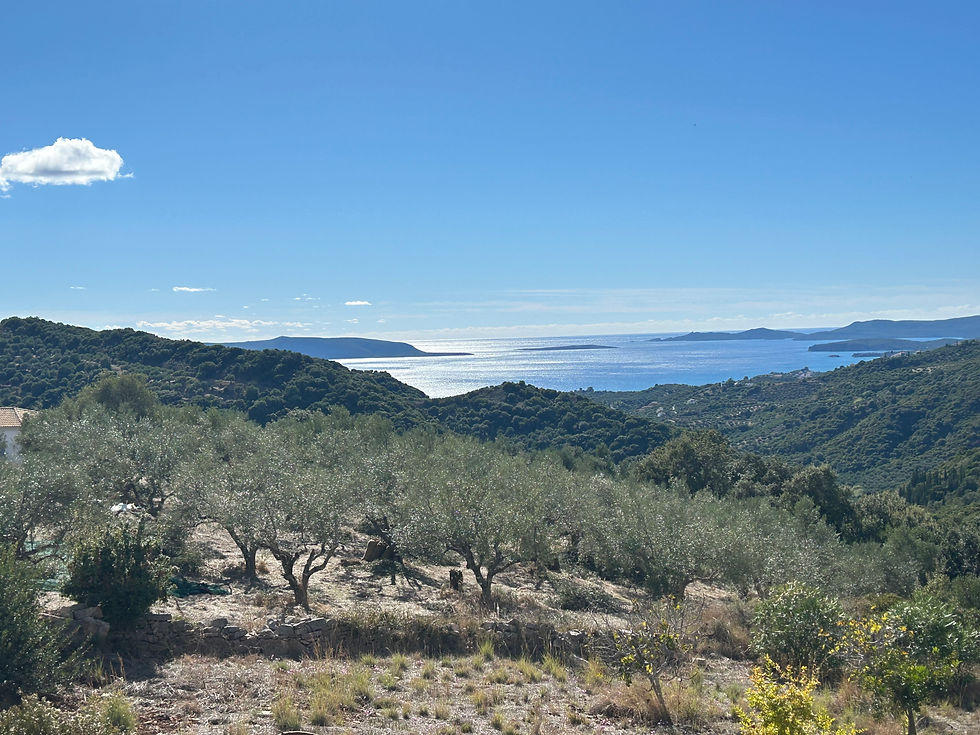
This year, the trees bear a remarkable quantity of olives. The branches bend under the weight of the fruit, still mostly green, with some pinkish and purplish hues.

For O Kairos, the objective remains the same: to harvest our Koroneiki early in order to produce an extra virgin olive oil with a pronounced vegetal character.
Everything seems to be in place to begin.
But the weather had other plans…
🌧️ Two rainy days to start
On October 12th and 13th, heavy rains fell on our region.
The sky darkens, the hills gradually disappear behind curtains of rain, and the olive groves take on a completely different appearance.
After the long, dry weeks of summer, the contrast is striking.

For olive trees, rain is part of the natural cycle. For those who have to harvest, it can become a real difficulty.
The ground becomes damp and slippery, the branches are soaked, and working conditions become difficult. We are forced to interrupt the harvest.
But some of the olives have already been harvested.

And that's where a very real problem arises…
Olives that have already been picked: an important decision
Approximately 500 kilograms of olives had already been harvested when bad weather disrupted our operations.
The olives are in several bags, but it is impossible to transport them to the mill immediately.
However, to preserve the quality of an extra virgin olive oil, the time between harvesting and pressing is an essential parameter.
Once detached from the tree, olives remain living fruits. Inappropriate storage conditions, particularly heat buildup or poor ventilation, can promote their deterioration.
At O Kairos, our usual goal is to have the olives processed every evening following their harvest.
This time, circumstances require us to wait much longer: about two days!
We need to make a decision quickly.
Rather than mixing these olives with those that will be harvested later, we choose to isolate this first batch and have it processed separately .
On October 14th, we headed towards another mill, in the Finikounda area.
We are awaiting the result with impatience…
85 liters of unfiltered oil: a nice surprise!
And what a surprise!

From these approximately 500 kilograms of olives come about 85 liters of unfiltered olive oil , of an intense green color, with the appearance of a real freshly extracted fruit juice.
The analysis indicates a free acidity of 0.4%, expressed as oleic acid .
An encouraging result, considering the particular conditions of this first harvest!
Free acidity is one of the physicochemical parameters used to characterize olive oil. To belong to the extra virgin category, it must not exceed 0.8%.
But low acidity alone is not enough to demonstrate that an oil is extra virgin: other analyses and an organoleptic evaluation are necessary.
We decided to keep these 85 liters for our personal consumption.
But this decision primarily responds to an essential requirement: to preserve the quality and identity of our emblematic vintage, the 100% Koroneiki – October Harvest.
By isolating this first batch, whose olives have waited almost two days before their transformation, we avoid taking the risk of altering the characteristics of our main harvest, which is processed at the Karambotsos mill under controlled conditions.
This year, this requirement takes on a special dimension: we wish to present our vintage at several prestigious international competitions, including the London International Olive Oil Competition, the Berlin Global Olive Oil Awards and the Los Angeles International Extra Virgin Olive Oil Competition .
For O Kairos, every decision counts when it comes to preserving the character and quality of our oil.
The harvest is off to a difficult start, but it is already giving us great satisfaction!
The return of the sun and the resumption of the harvest
After these two disrupted days, the weather is finally improving.
The harvest can resume!
The nets are spread out under the trees, the branches are worked to detach the fruit and the olives are gradually gathered.
Harvesting Koroneiki requires organization, attention, and a lot of work.
The trees need to be prepared, the nets positioned, the fruit collected, gathered together and its transport organized.
In our olive groves, where mature trees have very different shapes and sizes, each olive tree requires a certain adaptation.
This year, the fruit load is particularly high.
The branches covered in olives testify to the potential of this 2026 campaign.
And after the difficulties of the first few days, what a pleasure to see the bags filling up!
🌳 A harvest that mobilizes an entire team
Harvesting is not just about picking olives.
Behind every liter of oil, there are people, actions, experience, and a collective organization.
Nets spread on the ground, harvesting tools, branches laden with fruit, and bags filling up punctuate our days.
The work is physical, sometimes repetitive, but it remains deeply connected to the rhythm of the trees and the seasons.

For me, these days also represent one of the most important moments of the year: the moment when the work done in the olive groves finally takes a concrete form.
From the olive groves to the Karambotsos mill
Once the olives are harvested, another step begins: their transport to the mill.
For our main production, we work with the Karambotsos mill, located in the village of Ampelofyto, about forty kilometers from Kaplani, in Messenia.
From October 13th onwards, the olives are taken to the mill every evening, as the harvest progresses.
This organization allows us to limit the waiting time between harvesting and processing.
This is an essential step in our quality approach.
Upon arrival, the olives harvested from our plots are identified, weighed, and then taken into the mill's processing circuit.
The work in the olive groves then comes to an end, but a new, equally important phase begins.
Now it's the mill's turn to take over!
A particularly generous 2026 campaign
At the end of this first harvest period, the results are particularly satisfactory: 59 jute bags filled, representing nearly three tons of Koroneiki olives!
This represents approximately 550 liters for our main production , processed at the Karambotsos mill. We are still awaiting the final figures, but one thing is certain: this 2026 harvest is particularly bountiful!

A particularly encouraging volume for our olive groves!
But beyond the quantities, this harvest reminds us of an essential reality: producing quality olive oil requires knowing how to adapt.
We can observe the trees for months, prepare the plots, choose the harvest period and organize the work with precision.
The weather always retains an element of unpredictability.
This is also what makes each vintage different.
From fruit to oil: the continuation of our story
This 2026 harvest leaves us with powerful images: olive trees generously laden, a threatening sky over the hills of Messenia, rainy days, then the return of the sun and the work of the teams in the plots.
But once the olives arrive at the mill, how are they identified, sorted, washed, crushed, kneaded and separated to obtain their oil?
And how do we ensure their traceability throughout the process?
In our next article, I take you inside the Karambotsos mill to discover, step by step, the transformation of our Koroneiki into extra virgin olive oil.
A new opportunity to understand why every detail matters, from the tree to the oil.
🌿 O Kairos - The right time.

A bientôt !
Τα λέμε σύντομα!
See you soon!


Comments